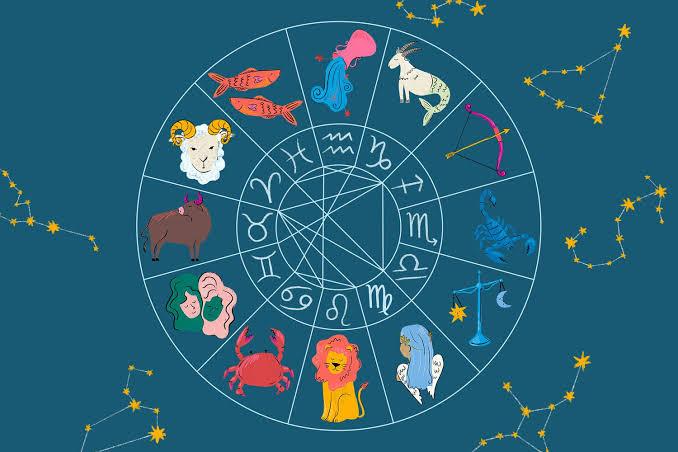
The zodiac is one of the most familiar concepts associated with the night sky. Many people know the names Aries, Taurus, Gemini, Cancer, Leo, Virgo, Libra, Scorpio, Sagittarius, Capricorn, Aquarius, and Pisces from astrology. But the astronomical meaning of the zodiac is more specific.
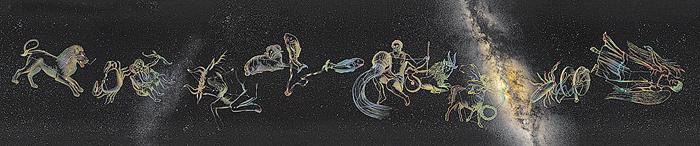
In astronomy, the zodiac refers broadly to the region of the sky surrounding the ecliptic. The ecliptic is the apparent yearly path of the Sun against the background stars. Because the major planets orbit the Sun in roughly the same plane, they also appear to remain close to this region of the sky.
The word zodiac also has a long historical connection with astrology. Ancient civilizations divided the ecliptic into recognizable regions and developed systems that connected celestial positions with calendars, seasons, mythology, and eventually astrological interpretation.
The zodiac is a band of the sky centered on the ecliptic. The traditional zodiac used in Western astrology is divided into twelve equal signs of 30 degrees each, making a complete circle of 360 degrees.
Astronomically, however, zodiac constellations are not equal-sized sections of the sky. The actual constellations have different shapes and apparent sizes, and the Sun can pass through different constellations for different lengths of time.
This distinction is important: a zodiac sign in astrology and a zodiac constellation in astronomy are related historically, but they are not the same thing.
The ecliptic is the apparent annual path of the Sun across the celestial sphere. It is produced by Earth's orbit around the Sun: as Earth moves through its orbit, the Sun appears to shift against the background stars.
The Moon and planets also remain relatively close to the ecliptic. Their orbital planes are not perfectly identical, but the Solar System is sufficiently flat that many of its most visible objects appear within the same general region of the sky.
This is why ancient sky-watchers repeatedly observed the same group of constellations along the path of the Sun, Moon, and planets. That region became especially important for calendars and later astrological systems.
The familiar Western astrological zodiac contains twelve signs. Each sign occupies an equal 30-degree segment of the zodiac circle.
The names of the signs are derived from constellations and ancient traditions, but the modern astrological sign system is an abstract division of the ecliptic rather than a direct map of the present-day constellations.
- Aries
- Taurus
- Gemini
- Cancer
- Leo
- Virgo
- Libra
- Scorpio
- Sagittarius
- Capricorn
- Aquarius
- Pisces
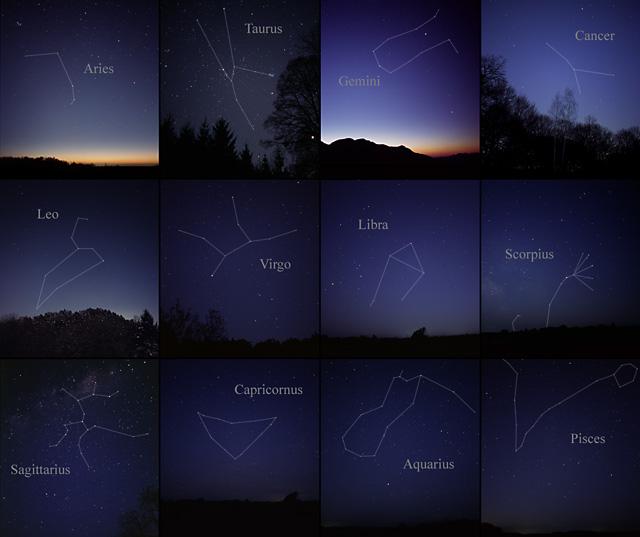
Aries is associated historically with the Ram and is one of the twelve traditional zodiac signs.
Taurus is associated with the Bull. The constellation contains prominent objects including the Pleiades star cluster and the bright star Aldebaran.
Gemini is associated with the Twins. Its two brightest stars are Castor and Pollux.
Cancer is a relatively faint constellation associated with the Crab. It contains the Beehive Cluster.
Leo is associated with the Lion and contains the bright star Regulus.
Virgo is one of the largest constellations in the sky and contains the bright star Spica.
Libra is associated with scales and lies between Virgo and Scorpius in the sky.
Scorpius is a prominent constellation with a curved shape resembling a scorpion. Its bright star Antares is especially noticeable.
Sagittarius is associated with the Archer and points toward the direction of the center of the Milky Way.
Capricornus is traditionally associated with a mythological sea-goat.
Aquarius is associated with the Water Bearer and is located along the ecliptic.
Pisces is associated with two fish and is the final sign in the traditional Western zodiac sequence.
The idea that there are exactly twelve zodiac constellations is a simplification. The Sun's actual path crosses more than twelve officially recognized constellations.
The International Astronomical Union defines constellation boundaries that cover the entire sky. When the Sun moves along the ecliptic, its apparent path crosses regions belonging to several constellations beyond the traditional twelve.
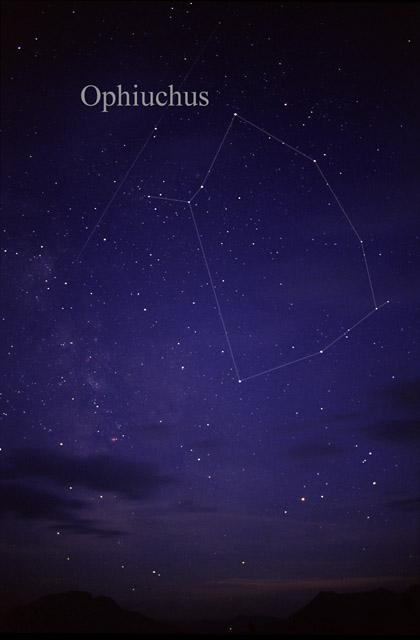
Ophiuchus is a large constellation near the ecliptic. Because the Sun passes through part of Ophiuchus during the year, astronomy recognizes it as one of the constellations crossed by the Sun's apparent path.
This is why Ophiuchus is sometimes called the 'thirteenth zodiac constellation.' However, that does not mean that the traditional Western astrological system suddenly contains a thirteenth sign. The twelve-sign astrological zodiac and the astronomical constellation map use different frameworks.
Modern astronomy treats constellations as officially defined regions of the celestial sphere. They are not simply pictures formed by stars; their boundaries define areas of the sky.
The International Astronomical Union established the modern boundaries of the 88 constellations used by astronomers. These boundaries allow astronomers to describe where objects are located in a standardized way.
The zodiac developed from ancient observations of the sky. Early civilizations tracked the movements of the Sun, Moon, and visible planets against the background stars because celestial cycles were useful for calendars, agriculture, navigation, and religious traditions.
Mesopotamian astronomers played an important role in the development of zodiacal systems. Later Greek astronomical and astrological traditions inherited and developed many of these ideas.
The twelve-sign division became especially influential because twelve is convenient for dividing the roughly 360-degree celestial circle into equal sections.
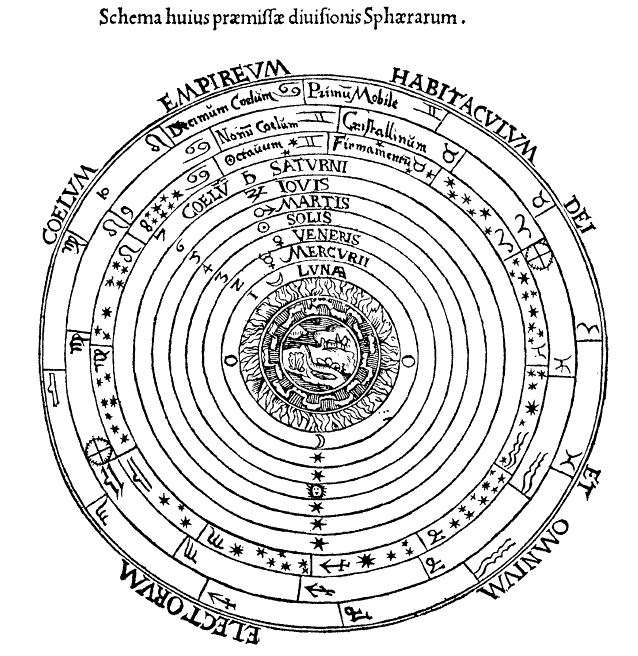
Astronomy and astrology share historical roots but have different purposes today.
Astronomy is a natural science concerned with celestial objects and phenomena. Astronomers study stars, planets, galaxies, black holes, radiation, gravity, planetary systems, and the large-scale structure of the universe using observations, mathematics, and physical theories.
Astrology is a cultural and divinatory tradition that interprets the positions of celestial bodies in relation to human lives and events. Its claims are not part of modern scientific astronomy.
One reason the traditional zodiac signs do not align exactly with the constellations today is the precession of Earth's rotational axis.
Earth's axis slowly changes its orientation over a long period. This gradual motion changes the position of the celestial coordinate system relative to the background stars.
As a result, the seasonal positions associated with traditional astrological signs have gradually shifted relative to the modern astronomical constellations.
Modern astronomy can measure and model the positions and movements of celestial objects with high precision. Astrology makes additional claims about relationships between celestial positions and human personality or events.
Controlled scientific research has not established astrology as a reliable method for predicting personality or future events. Astronomy, by contrast, is a scientific discipline supported by observation, mathematical models, and physical evidence.
Astrological descriptions often use broad personality statements. People can sometimes recognize themselves in general descriptions because such statements can apply to many individuals.
This does not require the descriptions to have a specific astronomical cause. Human psychology includes well-known effects that can influence how people interpret general statements about themselves.
Zodiac traditions are not identical across cultures. Western astrology developed around one system of signs, while other cultures developed different calendrical and astrological traditions.
For example, Chinese astrology uses a repeating cycle of years associated with animals and other traditional elements. Its structure is different from the twelve-sign Western zodiac.
The zodiac is useful as a way of understanding where the Sun, Moon, and planets appear in the sky. Astronomers can describe the apparent positions of these objects using celestial coordinates and constellation boundaries.
For amateur sky-watchers, recognizing the constellations near the ecliptic can make it easier to identify planets. Bright planets often appear as objects moving against the background stars along this region.
The zodiac is not a fixed glowing band surrounding Earth. It is a way of describing a region of the celestial sphere.
Depending on the season, location, time of night, and light pollution, different zodiac constellations will be visible. The Sun itself makes daytime observation of its background constellation difficult, even though the Sun is always located somewhere along the ecliptic.
Most planets appear near the zodiac because the Solar System formed from a rotating disk of material. The planets therefore orbit in relatively similar planes.
Their orbital planes are not perfectly identical, so planets can move somewhat above or below the ecliptic. Nevertheless, they generally remain within the same broad region of sky.
The ecliptic is closely connected with Earth's seasons. As Earth orbits the Sun and its axis remains tilted relative to its orbital plane, the Sun's apparent position changes throughout the year.
Traditional zodiac systems developed in cultures where tracking seasonal cycles was extremely important. This is one reason zodiac concepts became closely connected with calendars.
Several common claims about the zodiac mix together astronomical constellations and astrological signs.
- The twelve zodiac signs are not the same as the modern astronomical constellations.
- The constellations do not all have equal sizes.
- Ophiuchus is a constellation crossed by the Sun's apparent path, but traditional Western astrology still uses twelve signs.
- The zodiac is not a physical ring surrounding Earth.
- Astronomy and astrology are different fields with different methods and purposes.
Common questions about the zodiac can be answered by separating the astronomical and astrological meanings of the word.
The traditional Western astrological zodiac contains twelve signs.
The Sun's apparent path crosses more than the twelve traditional zodiac constellations, including Ophiuchus.
Ophiuchus is an astronomical constellation crossed by the ecliptic. It is not one of the twelve traditional Western astrological signs.
They have historical connections, but they are not identical. Modern astronomical constellations have defined boundaries and unequal sizes, while the traditional astrological signs divide the ecliptic into twelve equal sections.
One major reason is the long-term precession of Earth's rotational axis, which changes the relationship between seasonal coordinates and background stars over time.
The zodiac is both a historical cultural concept and an astronomical region associated with the ecliptic. Its traditional twelve signs are deeply connected to the history of astronomy and astrology, but they should not be confused with the modern astronomical constellations.
Understanding the difference between signs, constellations, and the ecliptic makes the subject much clearer. Astronomy describes what can be measured and observed in the sky, while astrology represents a separate historical and cultural tradition.